



Features
This piece is called a Shigaraki-style masterwork because it balances the rough, natural character of the clay against extremely elaborate hand-modelled work. Among antiques, vases of this kind belong to the Visual Art category of flower vessels, their aesthetic value having long since gone beyond that of a practical container.
1. Kiln transformation combining Shigaraki ware with shinsha copper-red glaze — The ground of the body shows the scarlet hi-iro and the feldspar grains typical of Shigaraki ware, the most elemental fired colour of the clay. On the modelled peonies the maker has boldly applied shinsha (Copper Red Glaze), a most demanding glaze that in reduction firing develops deep, oxblood-red layers, setting up a tense contrast of the wild and the opulent against the plain clay body.
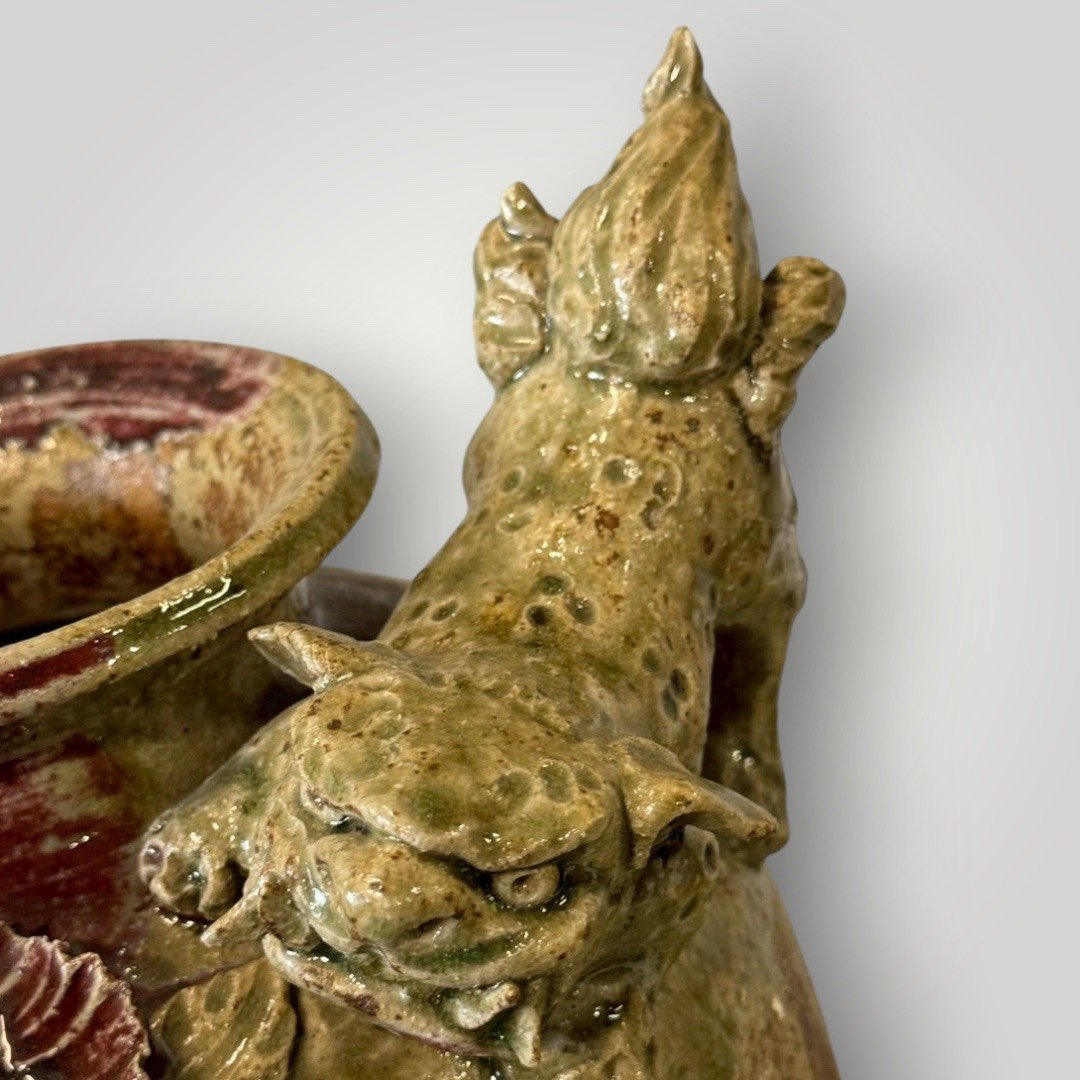
2. Exceptionally demanding hand-modelling and applied relief — Unlike ordinary painted decoration or shallow relief, the peonies and karajishi lions on this piece were **hand-modelled (te-zukune)** and then applied to the body. Working while the clay was half dry, the craftsman had to judge the thinness and the strength of each petal exactly, building up layer upon layer the fullness of a peony in bloom. Three-dimensional work of this kind greatly increases the risk of warping and cracking in the kiln, so every finished piece is one in ten thousand.
3. Climbing karajishi composition: a lively sacred guardian — The karajishi lion at the shoulder is not a stiff support but is caught in an upward climb. Its head turns towards the mouth of the vase, the expression stern, the mane and whiskers fully modelled, the lines vigorous. In East Asian decorative vocabulary a karajishi climbing among peonies stands for **courage and prosperity**, and this pairing of movement and stillness gives the vase the air of a guardian of the room.
4. Rich layers of kiln ash and running glaze — Look closely at the surface and you can see where the natural ash glaze has flowed. This runny glaze forms an irregular texture on the body, like the natural drape of a forest. Beauty arrived at by chance in this way is the essence of wabi-sabi: nothing is deliberately tidied, yet under light the piece reveals rich tactile and visual depth.