



Features
Five-clawed dragon among clouds: a supreme emblem — The dragon painted on the body has five claws, which in the traditional ceramic vocabulary denotes the highest rank and authority. The head is drawn with fine brushwork, the eyes wide and the whiskers flowing, conveying a sacred dignity that commands without anger; the scales are ordered in clear layers and the lines flow strongly, as though the dragon were moving through a sea of cloud — a perfect union of power and good fortune.
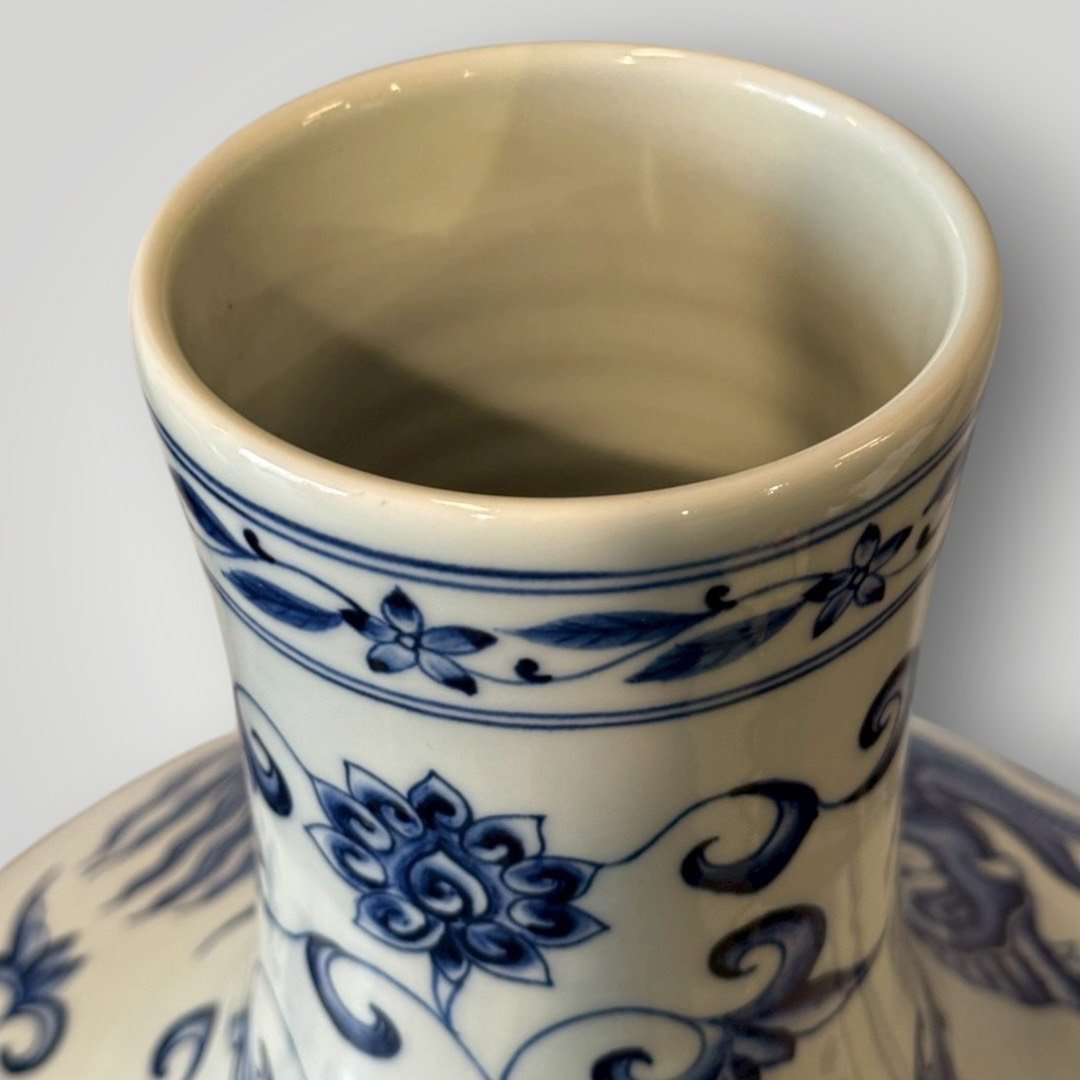
Blue-and-white tones: deep, composed layering — This piece shows sometsuke painting at the level described as ink in five shades. Varying the density of the cobalt separates the drifting cloud, the movement of flame and the solid body of the dragon. The colour is deep yet never sluggish, and against the snow-clean white porcelain body the blue appears all the more refined and full of depth.
A grand form: the rounded fullness of a tianqiu vase — The shape derives from the classic tianqiu, or celestial-sphere, vase, its belly as round and full as a globe, a form associated with the round heaven and square earth and with complete good fortune. Its imposing proportions, 46 cm tall, make it very hard to keep from warping during firing, which shows the kiln's precise command of high-temperature firing and of the clay recipe.
A distinctive mark: the bell-shaped seal on the base — The bell within a circular frame on the underside is this object's identifying sign. In Japanese culture a bell often carries the sense of praying for blessing and of spreading beauty; a mark of this kind usually indicates a favoured work of a particular kiln or craft circle, so beyond its artistic value the vase also carries something of the maker's spirit that can be researched.