



Features
A Japanese hand-carved wooden work, not a mass-produced article
This is a wooden ornament carved by hand by a Japanese craftsman. From the overall proportions and the turns of the lines to the layering of the feathers, the traces of cutting stroke by stroke are plain to see; it is not machine-pressed or mass-produced, and every piece has a uniqueness that cannot be copied.
The owl's expression is fully modelled, the eyes carved alive and alert
The contours of the owl's face are deeply cut, the brow ridges and eye sockets clearly layered, the gaze composed and reserved. It draws the eye strongly and becomes a natural focal point in a room — a work that is noticed at first glance.
Finely carved feathers, the knife marks and texture clearly visible
The plumage is rendered as layer upon layer, the knife work varying in depth and direction from the head to the breast and the wings. Seen close to, the rhythm and force of hand carving are unmistakable, and this is where much of the work's craft value lies.
Solid wood, with natural grain and a mellow colour
Carved from solid wood, the surface keeps the natural run of the grain and shows brown tones of varying depth. As the angle of light changes, the colour shifts through different layers; the quality is mellow and easy on the eye, very suitable for long-term display.
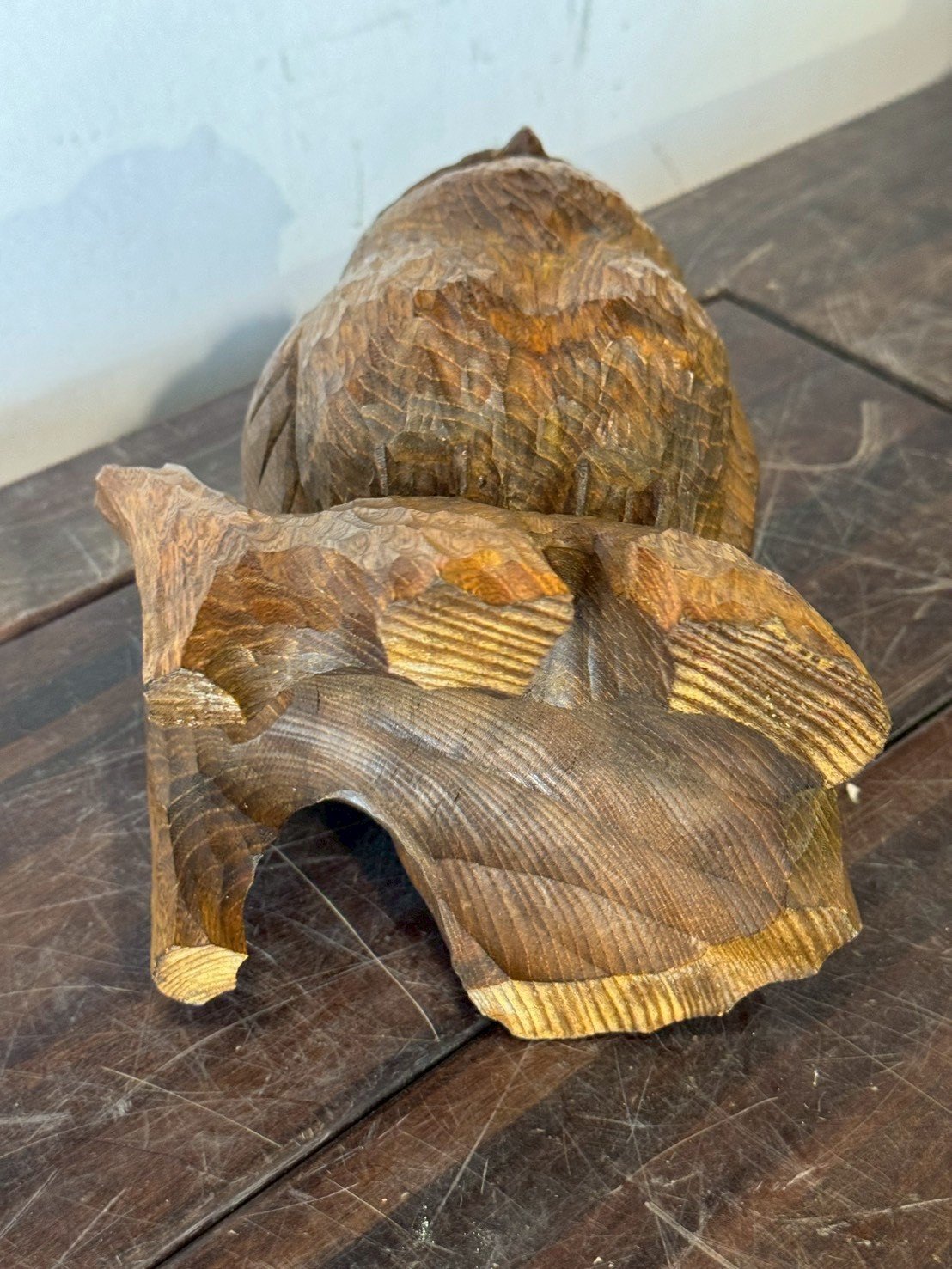
A tree-root base, stable overall and natural in style
The base imitates a natural tree root, bold in line but not disordered, letting the piece stand firmly while extending a woodland, natural atmosphere, so that the owl is not merely a single figure but a complete work on a natural theme.
At 25.5 cm high it has a full presence once in place
Compared with ordinary small wooden ornaments, this piece stands 25.5 cm high, a medium-to-large display size. Placed in an entryway, on a counter, in a display cabinet or on a shelf, it forms a clear visual centre and is not swamped by the objects around it.
Strongly Japanese wabi-sabi in style, rewarding to look at and never out of fashion
The style as a whole leans towards Japanese wabi-sabi, stressing nature, plainness, the traces of time and the essence of the material rather than excessive ornament or fashionable colour. It is a work that looks better the longer you see it and gains flavour the longer it stands, and it does not easily date in a long-held collection.
Fine cultural imagery, symbolic and carrying a blessing
In Japanese culture the owl is commonly regarded as a symbol of good fortune and is often seen in home ornaments, shop decoration and gifts, so beyond the pleasure of the carving itself there is an added value in its meaning.
A versatile wooden artwork for collecting, for styling and for giving
Whether for a collector of wood carving, an enthusiast of Japanese antique style, or someone who simply wishes to add quality and character to a room, this work is highly suitable, and it also makes a thoughtful gift for a shop opening, a new home or a house move.
Every piece is unique; once sold, the same one cannot be had again
Because it is hand-carved from natural wood, the grain, the colour and the knife marks can never be exactly alike. This is the only example, and once sold an identical work cannot be obtained again, so it has the collecting quality of a chance that does not come twice.