




Features
A broad 40 cm face: an ideal visual scale for a feature wall or entrance display.
Taishō taste: it keeps the fine drawing and lavish kinran gilding inherited from Meiji, while the brushwork is more observed from life.
Kinrande technique: gold paste and gold powder laid over one another give finely layered depth under light, opulent but not ostentatious.
A fully realised figural subject: expressions, dress and accessories are carefully drawn, so the scene tells its story clearly.
Decorated inside and out: the story in the well, brocade ground at the rim, scattered motifs and the mark on the reverse — three faces, all decorated.
The beauty of crazing: natural crackle and wear to the gilding give the wabi-sabi quality of age.
Easy to display: with a shallow curve 6.5 cm deep, it sits safely against a wall and stands firmly on a stand.
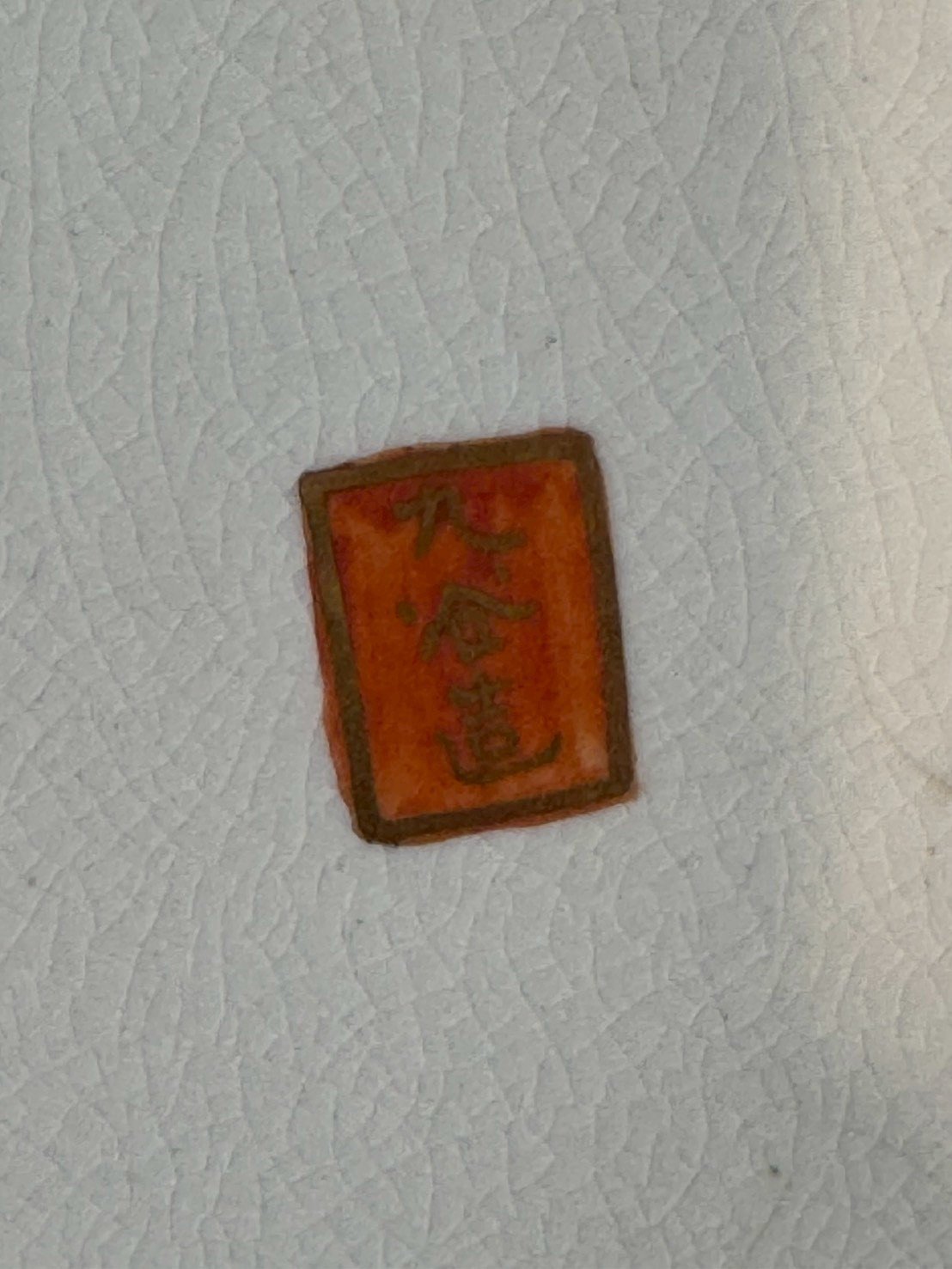
A clear collecting provenance: the reverse is marked "Kutani-zō" in gold on a red ground, making comparison with pieces of the same era straightforward.
A harmonious palette: ochre, green, ink black and gold dominate, so it sits comfortably in a modern home.
Photogenic: the reflections of the gilding and the richly detailed figures make it a striking backdrop for commercial spaces or dining scenes.
◆ Suggested settings and display
Entrance hall / living room display table: paired with a dark wood plate stand or a wall bracket, it forms a focal point in the room.
Tea room / tatami room: placed in the tokonoma or beneath a hanging scroll, it adds refinement and a cultural atmosphere.
Gallery / craft shop: as a representative display piece of Kutani craft.
Fine restaurants or hotels: adding Japanese artistic tone and cultural imagery.
A collector's cabinet: it can be shown alongside Kutani and Imari works of the same Meiji to early Shōwa period.