

Features
Authentic Bizen ware style
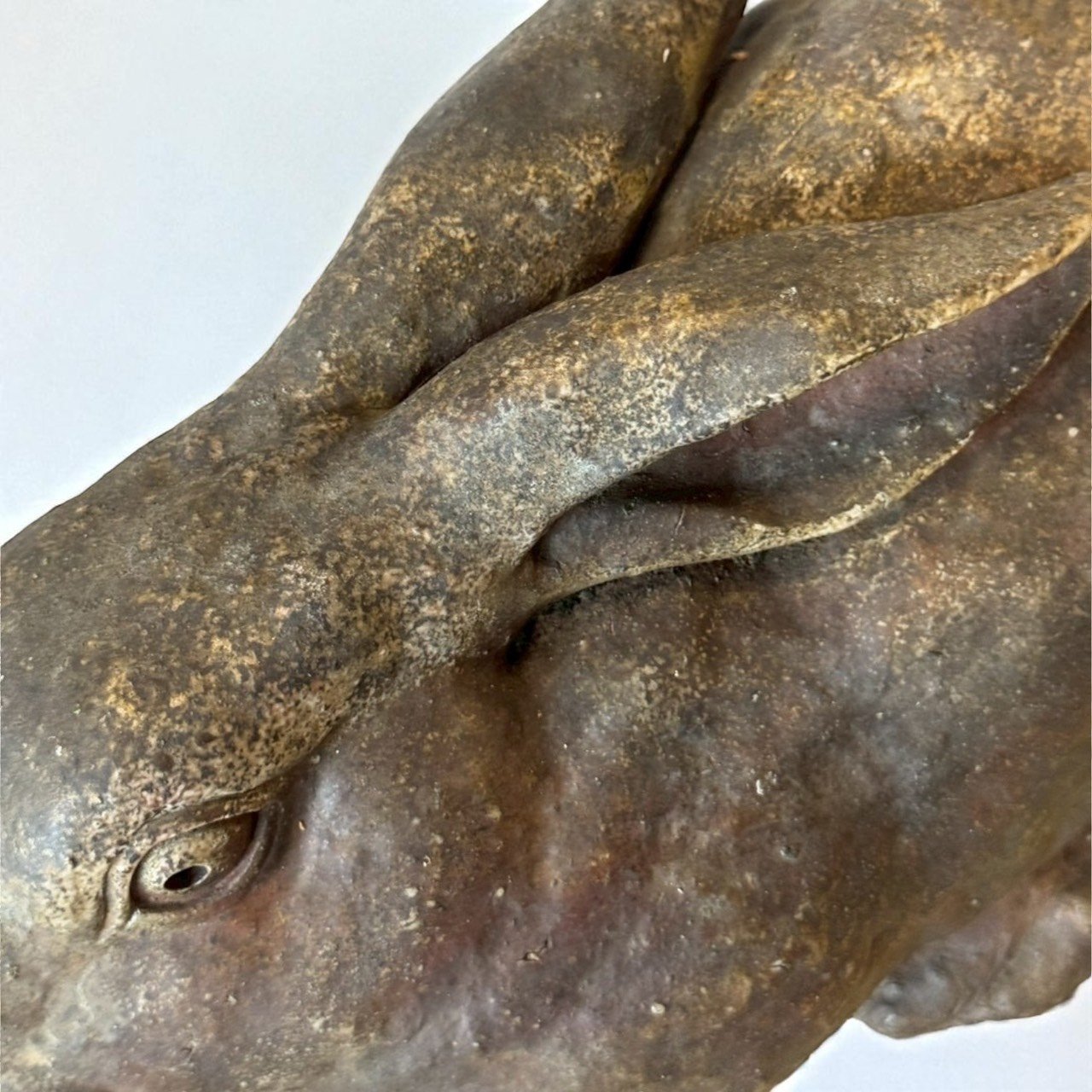
Unglazed yakishime firing is the core technique of Bizen ware. At high temperature the flame and wood ash act directly on the clay body, giving the work distinctive natural colouring, such as:
Goma (ごま): wood ash settling on the surface to form fine speckled glaze marks.
Hidasuki (ひだすき): partial oxidation producing orange-red bands.
Kiln-transformed grey shadows: a grey-black gradation resembling oxidised metal.
Several layers of natural transition can be seen on this rabbit, showing a long firing and a high command of controlling the path of the flame.
A representative work of wabi-sabi beauty
Bizen ware does not seek splendour but values the traces of nature and of time.
With its plain colouring, coarse texture and faint smoke marks, this work expresses the beauty of stillness and imperfection, letting one feel the vitality of ancient pottery.
An auspicious meaning: the rabbit as a creature of good fortune
In Japanese and East Asian culture the rabbit stands for peace and long life, nimbleness and happiness, moonlight and abundance.
In Japan especially, the rabbit is associated with the moon deity, prayer and the harvest, and is an emblem of the New Year, of moon-viewing and of peace in the home.
A composed and natural sculptural form
The body is rounded, the ears laid back and the gaze gentle, holding a balance between realism and abstraction.
The clay body is thick and the base stable, so it can be displayed safely on a wooden stand or on tatami.
A richly layered old-pottery surface
The surface has a dry yet mellow quality, and close up one can see fine mineral crystals and kiln marks.
Under light from different angles, a faint metallic sheen and stone-like reflections appear.
This natural quality, where earth and fire meet, is the most captivating characteristic of Bizen ware.
Valuable both as a collectable and as art
Bizen is one of the Six Ancient Kilns of Japan, with a history of more than a thousand years.
This piece combines craft, sculptural form and cultural symbolism, a rare subject for lovers of ceramics and collectors of antiques.
A medium mass with good presence on display
At 31 cm long it has presence in both a home and an exhibition space.
It may be displayed on its own, or grouped with a flower vase, an incense burner and a wooden stand.
A naturally developed patina
The surface carries very fine old marks and slight wear, natural traces of long keeping that bring out the texture and depth of passing time.
Excellent interplay with light
The outline and texture of the rabbit take on layers of shadow under side lighting, making it well suited to directional lighting as a feature piece in a room.
An emblem of quiet and of protection
The rabbit's posture is settled and its expression calm, so whether placed in an entrance hall, a study or a tea room it brings an air of peace and quiet.
◆ Suggested settings and pairings
At home: as the main display piece in an entrance hall, on the principal living-room cabinet, in a study or in the tokonoma.
Commercial spaces: a Japanese-themed corner in a tea room, dessert shop, select shop or guesthouse lobby.
Festivals / gifts: for the Year of the Rabbit, the coming of spring, the Mid-Autumn Festival, a housewarming or an opening.
Photography / display: a central prop for product settings, Japanese-style visuals and wabi-sabi themed exhibitions.