Live inventory from DASING's main warehouse | 235 pieces available
[ DASING Collection · Available Now ]

Available Now · Refined Antiques Where Time Stands Still

DASING Japan Art Warehouse currently has 186 pieces online, including tea ceremony utensils, Ko-Imari porcelain, maki-e lacquer and metalwork from the Edo to Shōwa periods. Each comes with its history and a record of its craftsmanship, awaiting the discerning collector.

100% direct from Japan More than vintage pieces — a slice of Japanese history worth collecting
Showing 145 - 153 (235 pieces in total)

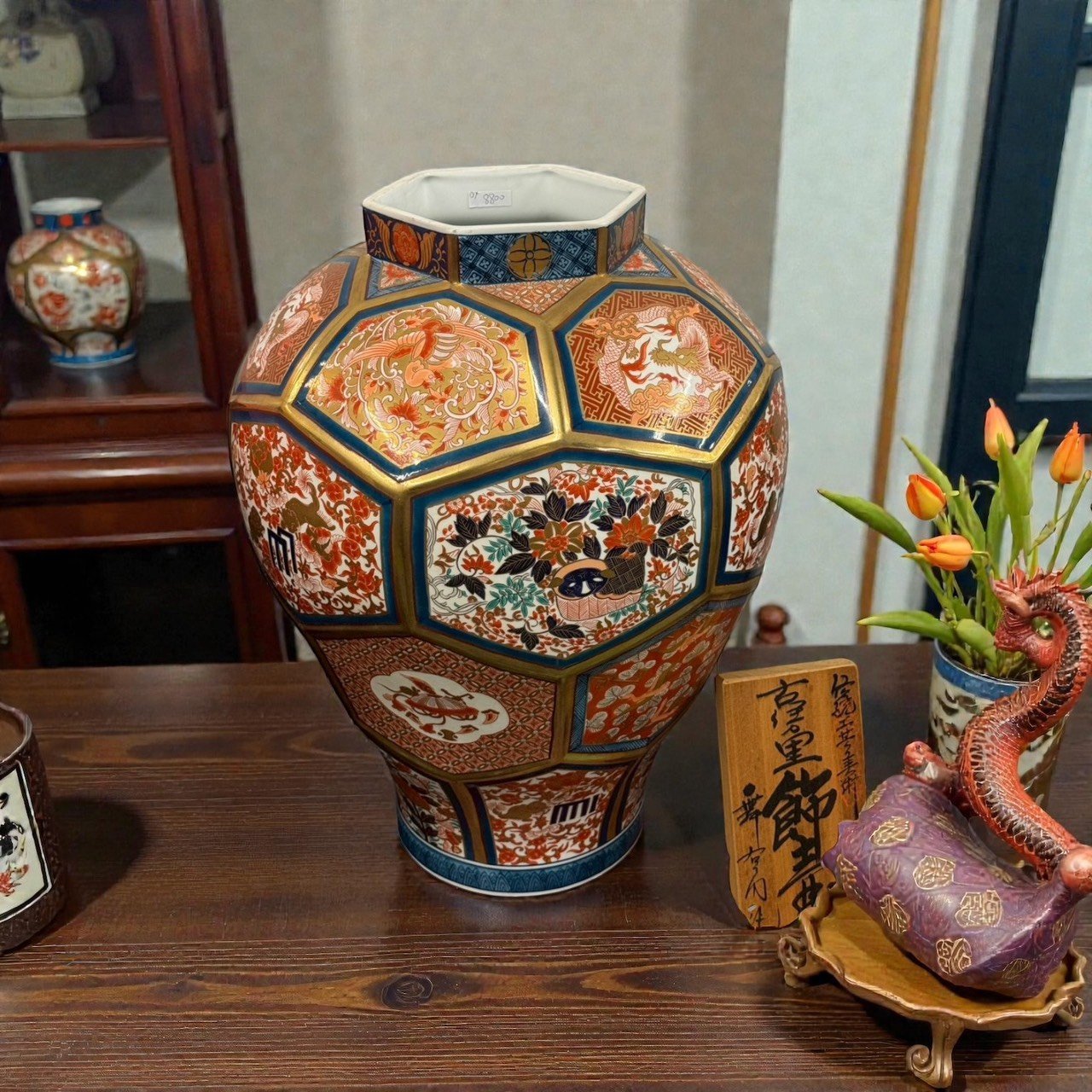
Ko-Imari Vase, Japan

This is an ornate large vase typical of the “Ko-Imari style.” The design is laid out in multiple panelled compositions (polygonal frames / tortoiseshell divisions), combined with gold enamel (kinrande / kinrande style) and rich, vivid Japanese overglaze painting, presenting the “festive, sumptuous, display-worthy” quality most representative of Imari-type works. The body shows several groups of motifs: floral patterns (large flowers and layered leaves in full colour); auspicious birds / phoenix designs (bird forms and auspicious imagery visible in some panels); karakusa scrolls / geometric brocade grounds (all-over background patterns adding density of detail); and gilt frame divisions (each panel outlined in gold, making the whole as sumptuous as brocade). The base bears the signature “Maiemon saku” (made by Maiemon), and it comes with an inscribed wooden box (tomobako), enhancing its completeness as a collector's piece and its standing for display; large boxed pieces like this are especially compelling as a focal point at home, in a shop display or in a clubhouse reception.

Price NT$ 8,800≈ US$ 275

Large Wooden Storage Cabinet with Mottled Bamboo, Japan

A large Japanese-style wooden storage cabinet whose most distinctive feature is the use of a “mottled bamboo (bamboo material) visual texture” for the shelf surfaces and door panels, creating a natural, unaffected, rustic beauty. It is framed in dark wood, combining three open display shelves above with a two-door storage cupboard below, serving both “display” and “storage.” As the photos show, the cabinet has solid lines and upright proportions, with an arched moulding at the top adding classical flavour and a softer look; the mottled bamboo texture of the shelves and doors has a strong material presence, and tea wares, antiques, bottles or books placed on it instantly bring out a Japanese wabi-sabi atmosphere. It is a practical piece of vintage furniture well suited as a main display in a shop or a focal point at home.

Price NT$ 39,800≈ US$ 1,255

Meiji-period Imari Ware Iro-e and Gilt Square Lidded Jar, Japan

This Meiji-period-style Imari ware square lidded jar in iro-e with gold enamel is commonly called a “general jar” by collectors because of its tall form, lid, full body and frequent use for display. The piece is built on a square form (standing on a square base of 15×15 cm); the body swells outward for solid proportions, topped by a stepped shoulder line and a knobbed lid, giving an upright, dignified silhouette that “anchors” a room. The decoration combines Imari's classic sometsuke blue (blue ground), iro-e (red, green and other colours) and gold enamel; the motifs include flowers (chrysanthemum-type) and arrangements of flowering plants, branches and leaves, with panelled brocade grounds and decorative bands. Dense in detail and rewarding both from afar and close up, it is a centrepiece antique that catches the eye at a glance, whether in a home entrance, in a living-room display cabinet or as a focal point at a shop entrance.

Price NT$ 5,800≈ US$ 185

Shōwa-period Edo Kiriko Vase, Japan

A blue glass vase in the style of Japan's Shōwa period, made mainly of deep blue glass, rich and steady in colour, with the retro character typical of Shōwa everyday objects. The body shows finely cut kiriko patterns, with floral and leaf motifs and curved compositions on the outer layer; the design is evenly distributed, retaining the crisp geometry of kiriko glass while bringing in the soft feel of traditional Japanese floral patterns, giving richer visual depth. In form it has a steady “narrow top, wide bottom” proportion; the wider base provides a good centre of gravity, making it more stable for flower arranging, and the slightly narrowed mouth naturally gathers the lines of the flowers, well suited to a single stem, slender branches and leaves, or a small bouquet. Under light the blue glass shows shifts between deep and pale tones and reflective highlights; whether in an entrance, at a tea setting, on a desk or in a display cabinet, it becomes a striking accent in a Japanese-style space. Suited to collectors who love the Shōwa style, glass craft and Japanese vintage objects, it also makes an excellent decorative piece for the home.

Price NT$ 1,800≈ US$ 57

Shōwa Folk-Craft-Style Large Ceramic Sleeping Cat

This sleeping-cat figure has a strong Shōwa folk-craft style. Modelled in clay, then glazed and fired, its form is naive and charming, with round, natural lines; rather than pursuing excessive realism, it presents the cat's relaxed, deeply sleeping posture in a way that “shows the warmth of the hand.” The cat's body is slightly curled, its head resting on its front paws and its expression settled, giving off a quiet, soothing atmosphere that makes you slow down without noticing when it is placed in a room. The glaze is mainly a blend of dark brown and grey-black with a glossy surface; under light it shows soft reflections and tonal gradations, making the piece appear more substantial and aged. Its size puts it in the “large ornament” class (33.5 cm long), so a single piece has plenty of presence and can become a focal point without much other decoration. Whether in an entrance to greet guests, on a living-room side table, on a study bookshelf, in a shop window or in a corner of a studio, it brings the warmth and everyday character unique to Japanese Shōwa vintage pieces, suiting collectors and decorators who love folk craft, art pottery, animal figures or a Japanese retro home style.

Price NT$ 2,000≈ US$ 63

Shōwa-period Paulownia Wood Hibachi, Japan

A paulownia wood hibachi from Japan's Shōwa period, designed as a round, globular volume; it looks solid and stately, its lines simple yet with great presence. The paulownia grain flows naturally, with light and dark tones interweaving into distinctive ripple and knot patterns; the grain of every wooden piece is different, and this “uniqueness” is the most appealing quality of vintage woodwork. Paired with a stand of the same wood, the whole looks more complete and sits more stably, lending the space the calm atmosphere of a Japanese tatami room. Inside is a copper liner — copper being heat-resistant and a good conductor of heat, a common arrangement in traditional hibachi — and with its lid it keeps out dust in everyday use and looks neater. Even if not used for burning, it is well suited as a display piece, storage container or flower vessel in a Japanese-style space. Wooden hibachi of this kind were common in Shōwa-period Japanese rooms, tea settings, ryokan and Japanese homes, objects combining everyday function with beauty; it suits collectors who love Japanese vintage pieces, the texture of woodwork and a wabi-sabi atmosphere. (With lid / with stand / copper liner inside; natural marks in the wood itself)

Price NT$ 5,800≈ US$ 185

Shōwa-period Small Paulownia Wood Hibachi, Japan

A small paulownia wood hibachi of a type common in Japan's Shōwa period. It is a simple cylindrical wooden piece with clean lines and solid proportions; placed on a table, it brings a strong atmosphere of Japanese household objects. Paulownia wood is light yet stable, with natural grain and a warm colour that deepens into an antique tone with years of use; inside is a copper liner, the heat-resistant inner vessel common in traditional hibachi, which also makes cleaning and maintenance easy. As shown in the photos, it comes with ash inside — the original condition in which this vintage piece was kept — giving collectors a stronger sense of its history of having “once been used.” Besides its traditional use as a hibachi (which requires proper ventilation and safety arrangements), small hibachi like this are now more often used for Japanese-style decoration and multipurpose storage: for example, for arranging branches and flowers, holding incense tools, storing small tea ceremony items, or as display props in a shop. Measuring 16.3 cm in diameter and 14.5 cm high, it is an easy-to-place, easy-to-match tabletop piece with just the right presence; acquiring 2–4 at once allows a matching set display, creating a ryokan-like, wabi-sabi atmosphere. (Shows signs of age; copper liner and ash included)

Price NT$ 1,200≈ US$ 38

Shōwa-period Japanese-Style Child Doll, Japan

This Japanese-style child doll embodies the “healthy beauty” and “sense of everyday life” characteristic of the Shōwa era; its round, full facial lines symbolize a pure wish for a flourishing family and the safety of children. Unlike imperial-kiln works that pursue extreme luxury, this folk-craft style is more approachable and unpretentious, and the mellow sheen of its glaze seems to carry the warmth of family life in that innocent era. It is not only a craft piece but also a quiet witness to history, bringing a timeless sense of calm and healing to modern spaces.

Price NT$ 650≈ US$ 20

Fukagawa Seiji Vase, Japan

This Fukagawa Seiji vase not only inherits the superb craftsmanship of the Meiji period but also strikes a perfect balance between simplicity and elaboration. Its signature “Mount Fuji” base mark symbolizes the craftsman's spirit of uncompromising quality and the supreme honour of imperial recognition. The deep blue of the body, like a clear sky after rain, contrasts vividly with hand-painted orange-red peonies, and with fine gilt outlining the whole work radiates an extraordinary regal elegance within its quietness. For collectors, the most appealing qualities of Fukagawa Seiji are the translucency and purity of its porcelain; even after decades, the glaze remains smooth and lustrous as a mirror. It is not only a vessel for seasonal flowers but also an artistic culmination fusing traditional Japanese aesthetics with the peak of modern craft; whether placed in the tokonoma of a Japanese room or in the entrance or living room of a modern minimalist home, it instantly adds cultural depth and dimension to a space.

Price NT$ 3,000≈ US$ 94
CURATOR'S SPECIAL SELECTION

This Season's Picks · The Beauty of Shōwa Silver and Metalwork

Go to Auctions
Shōwa Metalwork · Selected Silver

1952 Kobe Vintage STERLING SILVER Engraved Jewelry Cabinet

A small jewelry cabinet made in Kobe in 1952, crafted in STERLING SILVER. The double-door body is finely engraved with flowers and foliage, and the doors, hinges and clasps show layers of classical metalwork. Over the years the silver has naturally oxidized into varied tones and signs of use, making the delicate engraving stand out more vividly in light and shadow.

NT$ 88,000 Condition: visually very beautiful
View Details
DASING Japan Art Warehouse antique collection: metal seated figure in the style of Water-Moon Guanyin
BUDDHIST ART

Chinese Antique | Metal Seated Figure in the Water-Moon Guanyin Style

NT$ 30,000

Wearing an ornate jeweled crown, draped in celestial robes and necklaces, the figure sits in the "royal ease" posture, one leg raised and the other hanging naturally, capturing the graceful, relaxed pose of Water-Moon Guanyin. The face is lowered with a calm expression, and the bronze-toned finish is naturally deep and steady — well suited to a tea room, study or quiet space.

Selected Eastern Buddhist Art View Details
AUTHENTICITY & SAFE TRANSPORT

For DASING Collectors · Three Commitments for Peace of Mind

Every piece has weathered centuries. We bring an exacting, professional approach to antique art to every handover and delivery.

Sourced in Japan · Shipped to Kaohsiung

We keep searching all over Japan for antiques and vintage pieces with character — ceramics, tea ceremony utensils, vases, wood carvings, furniture and Shōwa-era goods — and bring them across the sea to DASING.

Real Photos · Shown as It Is

Items are photographed as they are, showing color, texture, detail and actual appearance as closely as possible, so buying online comes closer to seeing them in person.

Vintage Condition · Fully Described

Antiques often show wear, oxidation, kiln flaws, repairs or other signs of age. We show these as fully as we can in photos and item descriptions, so you can understand each piece before deciding to buy.